Liquefied natural gas (LNG) is natural gas that is cooled to approximately −162 °C to turn it into a liquid. In this state it takes up about 600 times less volume, which makes it easier to store and allows it to be transported by sea over long distances. Both figures are backed by the International Maritime Organization and the International Energy Agency.
This transformation has made it possible to transport natural gas between points that are not connected by pipelines. LNG can travel in dedicated vessels to terminals where it is stored, distributed in liquid form or regasified to feed it into the grid.
In addition to its role in energy supply, LNG is used as a fuel in certain modes of transport, including maritime. In this article we explain where it comes from, how it is produced and transported, how it differs from CNG and LPG and what its current role in transport is.
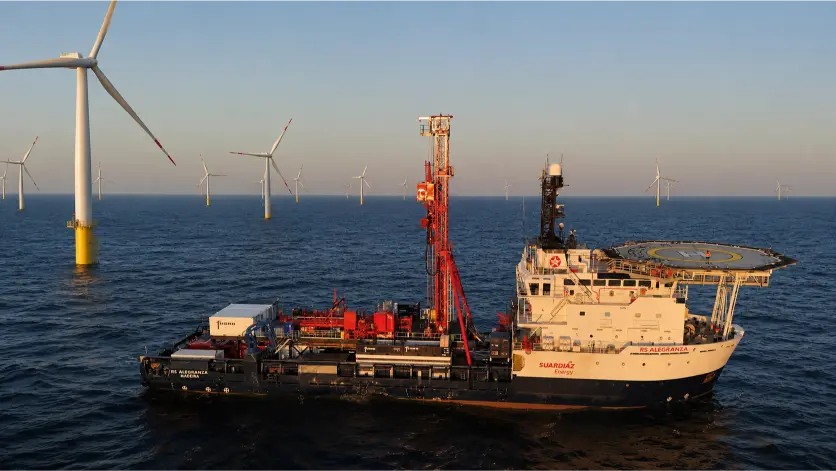
SUARDIAZ Group knows this technology from its own maritime operations and has added vessels with dual-fuel LNG propulsion to its fleet renewal plan.
What liquefied natural gas is and why it is liquefied
LNG is natural gas cooled to approximately −162 °C, the temperature at which it changes from a gas to a liquid at atmospheric pressure. When liquefied, its volume is reduced by about 600 times.
Therefore, LNG is not a different gas from natural gas. It is the same product in a different physical state, obtained through a cooling process called liquefaction.
Why turn it into a liquid? Mainly to make it easier to store and transport. Pipelines make it possible to transport gas when there is physical infrastructure between origin and destination. LNG offers another possibility: considerably reducing the volume of the gas and moving it in dedicated vessels.
Natural gas is made up mainly of methane, although its composition may include other hydrocarbons and components in proportions that vary depending on its origin. Before liquefaction it must be treated to remove certain components and impurities.
Before going further into the process, it is worth distinguishing several concepts that are often confused.
LNG, CNG, LPG and bio-LNG: what each acronym means
LNG and GNL refer to the same product. LNG stands for liquefied natural gas, and GNL is its Spanish name, gas natural licuado.
CNG, or compressed natural gas, is also natural gas, but it is stored in a gaseous state under high pressure. It does not go through the cryogenic liquefaction process used to produce LNG.
LPG, or liquefied petroleum gas, is different. It consists mainly of propane and butane and is stored as a liquid under pressure. Therefore, talking about LNG and LPG as if they were the same product is incorrect. The International Energy Agency expressly distinguishes between the two categories.
Finally, bio-LNG is liquefied biomethane. Unlike fossil-based LNG, it comes from renewable sources. Later we will see why this alternative matters for the evolution of methane-based fuel use.
As well as knowing these differences, it is important to understand what keeping LNG in a liquid state involves.
Properties and safety of LNG
LNG is a cryogenic liquid, meaning it is at an extremely low temperature. Handling it requires equipment, materials and procedures designed specifically to work in those conditions.
In its liquid state, LNG does not burn on its own. For combustion to occur, it must first evaporate and the resulting gas must be within a certain range of concentration in the air.
This does not mean that handling it is free of risk. Cryogenic temperatures can cause serious injuries on contact and affect materials that are not prepared to withstand them.
For this reason, its storage and transport require systems specifically designed to keep the product at cryogenic temperatures and to safely control any evaporated gas that may be generated.
Where liquefied natural gas comes from
LNG comes from natural gas extracted from onshore or offshore fields, which is then treated and put through an industrial liquefaction process. Conventional LNG is therefore a fossil fuel.
The process begins with the extraction of the natural gas. Before cooling it, it must be treated to remove components that could interfere with liquefaction. The International Energy Agency points to water, acid gases and heavy hydrocarbons, among others.
Once treated, the gas arrives at a liquefaction plant, where it is progressively cooled until it reaches the temperature needed to turn it into a liquid. It can then be stored in cryogenic facilities and loaded onto an LNG carrier for transport.
At destination, the process can be reversed. The LNG is unloaded and stored at a terminal and, when it needs to be fed into the gas grid, it goes through a regasification plant, where it is turned back from a liquid into a gas.
In Spain, this infrastructure carries significant weight within the gas system. Enagás operates LNG terminals and has a stake in other regasification facilities in the Spanish system.
It is worth distinguishing LNG and LPG again here: although both can be found in liquid form, their composition, origin and storage conditions are different.
At what temperature natural gas is liquefied and how liquefaction works
Natural gas is liquefied at approximately −162 °C at atmospheric pressure, the temperature at which its main component, methane, turns into a liquid.
To reach that temperature, the previously treated gas goes through a progressive cooling process. Industrial facilities use refrigeration systems that bring the temperature down to the necessary cryogenic conditions.
Once converted into a liquid, LNG is stored in specially insulated tanks. The aim is to limit the entry of external heat as much as possible and maintain the conditions needed to keep it liquid.
However, no insulation system completely eliminates heat transfer. During storage and transport, a small part of the LNG may return to a gaseous state. This phenomenon is known as boil-off gas.
Managing this gas is part of the operation of storage systems and LNG carriers. Depending on the design of the facility or vessel, it can be handled in different ways, including using it as fuel.
How LNG is transported and stored
LNG needs to maintain cryogenic conditions throughout its entire logistics chain. From the liquefaction plant to the point of consumption, infrastructure specifically designed to store and move it in liquid form is used.
Being able to transport it this way is precisely one of its defining characteristics: it makes it possible to move large quantities of natural gas without depending solely on a pipeline connection.
Maritime transport is one of the main links in this chain.
LNG carriers: the maritime link
Maritime transport of LNG is carried out by LNG carriers, vessels specially designed to transport the product at cryogenic temperatures.
Their containment systems insulate the cargo from the outside and keep it in a liquid state during the voyage.
Two main configurations exist among the technologies used. Moss systems use large independent spherical tanks, easy to identify from outside the vessel. Membrane systems, for their part, integrate the tanks into the structure of the hull.
Both technologies address the same challenge: transporting LNG safely while maintaining the necessary cryogenic conditions during the voyage.
Once the vessel arrives at its destination, the next link in the chain begins.
Terminals and regasification plants
LNG terminals receive the product carried by LNG carriers and store it in large cryogenic tanks.
From there, LNG can follow different routes. It can be kept in liquid form for later distribution or used as fuel, or it can go through a regasification process to be fed into the gas grid.
Regasification is essentially the reverse of liquefaction: the LNG receives heat in a controlled way until it returns to its gaseous state.
This infrastructure connects maritime LNG transport with land-based supply systems.
Road distribution using cryogenic tanker trucks
LNG can also be distributed by road in tanker trucks specifically prepared to carry cryogenic products.
This option makes it possible to take LNG from terminals to facilities that need to receive it in liquid form, including certain industrial consumption points or fuel supply installations.
The combination of maritime transport and land distribution shows how LNG logistics can integrate different modes of transport within a single chain.
Differences between LNG, CNG and LPG
LNG, CNG and LPG are not the same fuel. Although their acronyms can cause confusion, they differ significantly in composition, storage method and required infrastructure.
LNG and CNG come from natural gas and consist mainly of methane. The fundamental difference lies in how they are stored: while LNG is cooled until it becomes a liquid, CNG remains gaseous and is stored at high pressure.
LPG, for its part, consists mainly of propane and butane. It is stored as a liquid under pressure and does not need the cryogenic temperatures characteristic of LNG.
| Criterion | LNG (liquefied natural gas) | CNG (compressed natural gas) | LPG (liquefied petroleum gas) |
| Main composition | Methane | Methane | Propane and butane |
| Origin | Natural gas | Natural gas | Oil refining and natural gas processing |
| Storage | Liquid at about −162 °C | Gas compressed at high pressure | Liquid under pressure |
| Stored state | Cryogenic liquid | Gaseous | Liquid |
| Common uses | Transport, industry and energy supply | Transport and facilities connected to gas infrastructure | Domestic, industrial and transport uses |
| Infrastructure | Cryogenic facilities | High-pressure systems and tanks | Tanks and pressure systems |
The main practical consequence is energy density per unit of volume. The volume reduction achieved through liquefaction makes it easier to store larger quantities of natural gas and transport it over long distances.
That is why LNG is used, among other applications, in heavy-duty and maritime transport. CNG has other applications in mobility and LPG belongs to a different supply chain and different uses.
What liquefied natural gas is used for
LNG makes it possible to store and transport natural gas in liquid form, so it has applications in energy supply as well as in industry and transport.
One of its main uses is supplying gas systems. Maritime transport makes it possible to carry LNG from liquefaction plants to terminals in other markets. There it can be regasified and later fed into the grid.
Natural gas is also used for power generation and as an energy source in industrial processes. At facilities far from the gas grid, LNG can be distributed in cryogenic tankers.
Another application is heavy-duty transport, both by road and by sea. In the maritime sector, it can be used as fuel in engines specifically designed or prepared to run on natural gas.
This last application has gained relevance as the maritime sector faces increasingly demanding requirements on emissions and energy efficiency.
LNG as a fuel in maritime transport
LNG is used as a marine fuel that serves as an alternative to conventional petroleum-derived fuels and currently has operational technology and supply infrastructure.
Its combustion offers particularly clear advantages in terms of air pollution. The International Maritime Organization notes that gaseous fuels generate very low levels of air pollutants such as sulfur oxides (SOx) and particulate matter.
However, this does not make LNG an emission-free fuel. Its combustion still generates CO₂ and its climate balance must also take into account the methane emissions associated with the supply chain and with the operation of certain engines.
For this reason, it is more accurate to see LNG as an available technology within the energy transition of maritime transport, with advantages and limitations that must be assessed across its whole life cycle.
One of the operations needed to use it as a fuel on a vessel is bunkering.
What LNG bunkering is
Bunkering is the operation by which fuel is supplied to a vessel. When the fuel used is LNG, the operation must be carried out with equipment and procedures prepared to work with a cryogenic product.
Supply can be arranged in different configurations, for example from a tanker truck, from a shore-based facility or from another vessel specifically prepared to carry out the operation.
Because of their characteristics, these operations require specific safety procedures, coordination between the parties and equipment compatible with LNG supply.
Discover how LNG bunkering works and the main ways of supplying vessels
The use of alternative fuels in maritime transport is also closely linked to the evolution of international and European regulations.
The regulatory framework driving the transformation of maritime transport
The reduction of maritime transport emissions is shaped by an increasingly demanding regulatory framework, at both international and European level.
In 2023 the International Maritime Organization adopted a revised strategy to reduce greenhouse gas emissions from ships, setting a pathway towards net-zero emissions from international shipping around 2050.
In the European Union, FuelEU Maritime has applied since 2025 and sets a progressive reduction in the greenhouse gas intensity of the energy used on board certain vessels. The target starts with a 2% reduction in 2025 compared with the 2020 reference value and increases progressively in the following decades. In addition, its calculation covers CO₂, methane and nitrous oxide across the fuel’s life cycle.
Maritime transport has also been included in the EU ETS since 2024. In 2026, in addition to CO₂, the system brings methane (CH₄) and nitrous oxide (N₂O) emissions from maritime transport within its scope.
This brings ships’ emissions into the economic equation of European maritime operations and reinforces the need to assess fuels, technologies and efficiency measures from a regulatory compliance and cost perspective.
Real advantages and limitations of LNG
LNG has mature technology and storage and supply infrastructure that is already developed, which allows it to be used today in certain maritime and land operations.
Compared with conventional marine fuels, one of its clearest advantages is the reduction of certain air pollutants, especially sulfur oxides and particulate matter. This is particularly relevant in ports and in areas close to cities.
In addition, infrastructure and engines prepared for LNG can offer a route to gradually incorporating bio-LNG, provided the fuel used meets the corresponding technical and regulatory requirements.
However, conventional LNG remains a fossil fuel and has limitations that must be considered when assessing its climate impact.
One of the main ones is so-called methane slip: methane emissions that can occur without being fully burned. This is especially relevant because methane is a potent greenhouse gas.
In fact, since 2026 the EU ETS has covered methane from maritime transport among the gases in the system, reflecting the growing regulatory importance of controlling these emissions.
Therefore, the impact of LNG should not be assessed only from the emissions produced during combustion. It is necessary to consider the fuel’s life cycle and the possible methane emissions associated with its production, transport and use.
Bio-LNG: the renewable version of liquefied natural gas
Bio-LNG is biomethane that has been liquefied to turn it into a liquid fuel at cryogenic temperatures.
Biomethane can be produced by treating organic matter and, once purified to the necessary specifications, it can be liquefied by a process equivalent to the one used for natural gas.
One relevant feature is that it can be used in infrastructure and technologies compatible with LNG, which opens a possible path of evolution for assets currently prepared to use liquefied natural gas.
However, its environmental impact cannot be taken for granted simply because of its renewable origin. It depends, among other factors, on the feedstock used, the production process and compliance with the applicable sustainability and traceability criteria.
In addition, its availability is currently more limited than that of fossil-based LNG. For this reason, bio-LNG represents a possible path of evolution for certain uses of liquefied natural gas, but its development also depends on increasing the production and availability of sustainable biomethane.
LNG in SUARDIAZ Group’s Maritime Operations
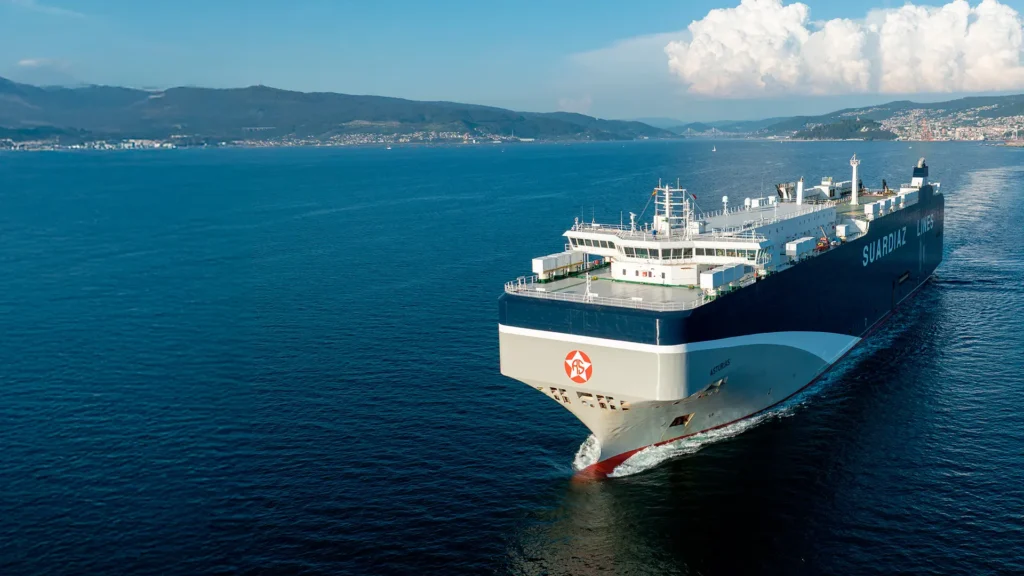
The use of liquefied natural gas in maritime transport is also part of SUARDIAZ Group’s fleet renewal strategy, which includes the introduction of new PCTC (Pure Car and Truck Carrier) vessels equipped with dual-fuel LNG propulsion technology.
The first of these new vessels is RS ATLANTICO, with a capacity of 5,500 Car Equivalent Units (CEU) and dual-fuel technology that enables it to operate using liquefied natural gas.
Its introduction marks an important step in the Group’s fleet modernisation and its adaptation to the evolving requirements of maritime transport, incorporating technologies that can reduce certain pollutant emissions compared with conventional marine fuels.
This project is part of SUARDIAZ On Course, the campaign highlighting the key milestones of the fleet renewal programme and following the progress of the new vessels.
Find out how Grupo Suardiaz incorporates sustainability criteria into its maritime and multimodal transport solutions. Request further information with no obligation!
How much does the volume of natural gas shrink when it is liquefied?
When converted into LNG, natural gas takes up approximately 600 times less volume than in its gaseous state, which makes it easier to store and transport. This ratio is reported by the International Maritime Organization (IMO).
Is liquefied natural gas dangerous?
LNG requires specific safety procedures mainly because of its cryogenic temperature and the flammable nature of the gas when it evaporates and mixes with air at certain concentrations. The equipment, systems and procedures used are designed specifically to manage these risks.
Why is LNG used on ships?
LNG can be used as a marine fuel and offers advantages over conventional fuels in certain air emissions, especially sulfur oxides and particulate matter. However, it remains a fossil fuel and its climate assessment must also take methane emissions into account.
Liquefied natural gas is a well-established technology that makes it possible to transport natural gas over long distances and use it in different energy and transport applications. In the maritime sector it offers operational advantages and benefits in certain pollutant emissions, but it also has limitations that must be considered, especially its fossil origin and possible methane leaks.
How regulation evolves and how alternatives such as bio-LNG develop will determine its role in the energy transition. For companies that rely on maritime transport, understanding these characteristics makes it easier to see how the fuels used by ships increasingly influence
emissions, regulatory compliance and the costs associated with transport.