A documentation error can turn into an operational problem long before the goods reach their destination. An incorrect description, a package count that does not match or incomplete details can cause incidents during an international shipment.
That is why documents such as the commercial invoice, the packing list and the Bill of Lading need especially careful review.
The Bill of Lading, also known as the BL or B/L, is one of the fundamental documents of international maritime transport. It identifies the parties involved in the operation, records information about the goods and sets out the conditions under which they are transported.
For companies that import or export goods, understanding what information it contains and checking that the details are correct is essential to maintaining proper document control throughout the operation.
What the Bill of Lading is and what it does
The maritime Bill of Lading is a document issued by the ocean carrier, or on its behalf, that acknowledges receipt of the goods for transport and sets out the conditions applicable to the operation.
In practice, it serves three main functions.
- It works as a receipt for the goods, recording the cargo received for transport and the information declared about it.
- It also evidences the contract of carriage by sea and its terms.
- Finally, certain Bills of Lading act as documents of title, which allows certain rights over the goods to be transferred by transferring the document.
This last feature is especially important. The Bill of Lading should not be understood as a simple administrative record: it can have legal effects on the delivery of the goods and forms part of the contractual relationship between the parties.
For this reason, correctly reviewing the information before issuing or accepting the document is essential.
Who issues the Bill of Lading: Master BL and House BL
Who issues the Bill of Lading depends on how the transport operation is structured.
When a shipping line is directly involved, it may issue the Master Bill of Lading (MBL). When the operation is handled through a freight forwarder or NVOCC, a House Bill of Lading (HBL) issued by the forwarder may also exist.
The difference between the two documents lies mainly in who issues them and which transport relationship they document.
Master Bill of Lading
The Master Bill of Lading documents the transport relationship with the shipping line. In operations handled through a freight forwarder or NVOCC, the forwarder may appear as shipper and/or consignee in relation to the carrier, depending on how the operation has been structured.
House Bill of Lading
The House Bill of Lading is issued by the freight forwarder or NVOCC to its customer and documents that transport relationship.
Therefore, a Master BL and one or more House BLs can coexist in the same operation. Understanding which document corresponds to each contractual relationship is especially important for tracking the shipment’s documents correctly.
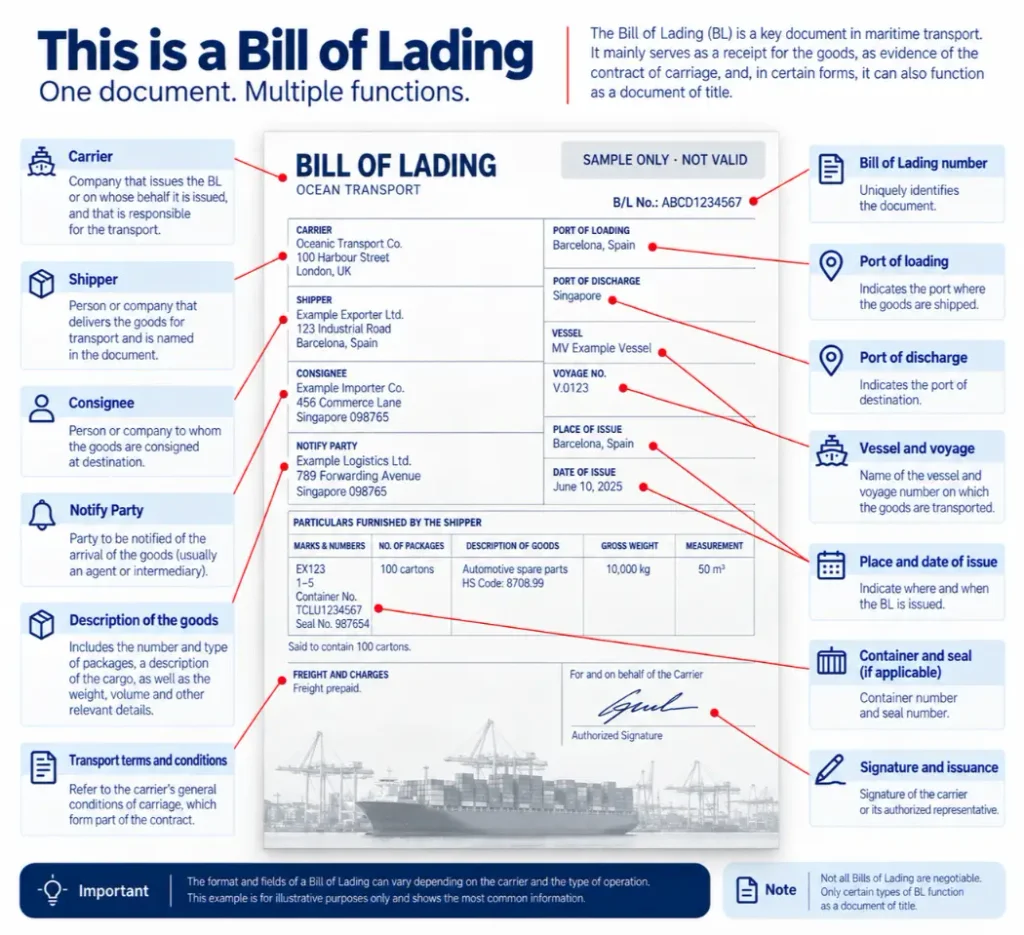
What information does a Bill of Lading contain (with example)
Although the format may vary by carrier, a Bill of Lading contains the main data needed to identify the operation, the parties and the goods transported.
The fields worth checking include:
- Shipper: party named as the sender of the goods.
- Consignee: party to whom the goods are consigned.
- Notify party: person or company that must receive the arrival notice, where applicable.
- Port of loading and port of discharge.
- Vessel name and voyage number.
- Description of the goods, including the corresponding details on type, weight and volume.
- Number of packages.
- Container number and seal, where applicable.
- Date of shipment.
- Freight terms, such as prepaid or collect.
The accuracy of these fields is especially important. The description of the goods, the weight or the number of packages must match the information for the operation and the rest of the commercial documentation.
A discrepancy can cause documentary, customs or delivery issues. That is why the Bill of Lading should be reviewed before final issue, and any error should be reported to the operator as soon as possible.
Bill of Lading and equivalent transport documents
Although the term Bill of Lading is directly associated with maritime transport, other modes of transport use documents that serve equivalent functions within their own operations.
Knowing the differences between these documents is especially important in multimodal operations, where the same goods may travel different legs by sea, air or road. Not all of them have the same characteristics or produce the same legal effects.
Maritime Bill of Lading
The maritime Bill of Lading is the document used for the carriage of goods by sea. As we have seen, it acknowledges receipt of the goods, evidences the contract of carriage and, in certain forms, can act as a document of title.
This last feature sets it apart from the documents typically used in air and road transport.
Its correct issue and review take on special importance in international operations where the delivery of the goods or certain commercial transactions are linked to the transport documents.
Air Waybill: the air transport equivalent
In air transport, the reference document is the Air Waybill (AWB). This document evidences the contract of carriage between the shipper and the air carrier and records essential information about the shipment.
Unlike certain maritime Bills of Lading, the AWB is a non-negotiable document. Therefore, it does not work as a negotiable document of title to the goods.
The AWB identifies, among other details, the shipper and the consignee, the airport of departure, the route and destination, as well as information on the goods and the charges associated with the carriage.
CMR consignment note: the road transport equivalent
In the international carriage of goods by road, the reference document is the CMR consignment note.
This document evidences the contract between the carrier and the sender for the carriage of goods by road and records information about the parties, the goods and the operation. Its use is governed by the Convention on the Contract for the International Carriage of Goods by Road (CMR).
Unlike the negotiable maritime Bill of Lading, the CMR consignment note does not work as a negotiable document of title. Its main function is to document the contract of carriage by road and to record the conditions and information of the operation.
Understanding which document corresponds to each mode of transport is especially relevant when an operation combines several of them, since a BL, an AWB and a CMR consignment note are not interchangeable documents.
Original Bill of Lading, Telex Release and electronic Bill of Lading
The way the Bill of Lading is handled can also vary. The traditional paper document still coexists with release procedures that do not require physical presentation and with fully electronic solutions.
In the case of an original Bill of Lading, delivery of the goods may be conditional on presenting the corresponding original document at destination, depending on the type of BL and the terms of the operation.
The Telex Release allows the goods to be released at destination without the consignee having to physically present the original Bill of Lading. To do so, the procedure must be arranged beforehand with the carrier and the necessary conditions to approve the release must be met.
This system avoids sending the physical document to the destination, which is especially useful when the goods may arrive before the original documents.
Meanwhile, the industry is moving towards the electronic Bill of Lading (eBL), which allows the document to be managed in digital format. Its development aims to reduce reliance on paper and speed up the exchange of documents between the parties involved in an operation.
The legal framework for maritime transport and Bills of Lading is also shaped by international conventions. Among the most relevant historical and legal references are the Hague and Hague-Visby Rules, which govern certain aspects of the maritime carrier’s liability.
How to fill in a Bill of Lading without errors
Filling in a Bill of Lading correctly requires checking that the information in the document matches the reality of the operation and the rest of the commercial documentation.
The details of the shipper, consignee and notify party must be reviewed carefully. The port of loading and discharge, the vessel name and voyage number and any other reference needed to identify the shipment correctly must also be checked.
Particular attention is needed for the description of the goods, the number of packages and the declared weight. These details must be accurate and consistent with the documentation of the operation.
When dangerous goods are carried, they must be correctly identified and declared in accordance with the requirements applicable to transport.
Before accepting the final version of the Bill of Lading, review all its fields and request any necessary corrections. Information that does not match the reality of the cargo must not be accepted.
If there is any doubt about a detail, the right course is to resolve it with the operator before the document is finally issued and, above all, before the vessel sails.
Why manage your Bill of Lading with Grupo Suardiaz
Document management is part of an international transport operation and requires coordination between the goods, the mode of transport used and the corresponding customs procedures.
Grupo Suardiaz combines its activity as a shipowner with a logistics offering that integrates maritime, air and land transport and multimodal solutions, which makes it possible to handle different transport documents depending on the characteristics of each operation.
In the customs field, Grupo Suardiaz holds Authorised Economic Operator (AEO) status and has customs warehouses at different locations in Spain.
Its international presence is complemented by Group companies such as Somaloir in France, contributing to the management of international operations in different markets.
The Bill of Lading is not just an administrative document. It acknowledges receipt of the goods, evidences the contract of carriage and, in certain forms, can act as a document of title.
That is why checking who issues it, what information it contains and that all details match the operation is essential before final issue. Rigorous document management helps reduce errors and supports the correct coordination of international transport.
Contact us, with no obligation!