When a company needs to transport large volumes of cargo, high-tonnage machinery or cargo with special requirements, regular maritime transport lines do not always offer the necessary flexibility or capacity. In these cases, ship chartering becomes a strategic solution for adapting transport to the specific needs of each operation.
Unlike transport on regular services, chartering makes it possible to secure an entire vessel or part of its capacity through a contract that defines aspects such as the type of cargo, the itinerary, the duration of the service or the responsibilities of each party. This option is particularly useful in sectors such as automotive, energy, steel manufacturing or industrial projects, where logistics planning and space availability are critical factors.
At Grupo SUARDIAZ, we approach this guide from a particular position: our dual status as a global logistics operator and long-standing shipowner allows us to understand chartering both from the perspective of the party contracting it and from that of the party operating the vessel.
In this guide, we explain what ship chartering is, what types exist and what aspects should be considered before contracting this type of service. We also look at the main elements of a charter party and how it applies to highly complex logistics operations.
What ship chartering is and who is involved
Ship chartering, also known as vessel chartering, is a contract regulated under Spain’s Law 14/2014 on Maritime Navigation, whereby one party makes a vessel, or part of its cargo capacity, available to another in exchange for payment of a price known as freight. Depending on the type of agreement, the contract may be limited to a specific voyage, extend over a set period, or even involve transferring the vessel without crew.
This type of contract plays a fundamental role in international trade because it makes it possible to adapt transport capacity to the real needs of each operation, optimising costs and guaranteeing space availability for goods that, due to their volume or characteristics, cannot be transported through conventional services.
Every charter party involves two main parties:
The owner (fletante) is the party that makes the vessel or cargo space available to the client. This is usually the shipowner or the shipping line that commercially operates the vessel.
The charterer (fletador) is the company that contracts the transport to move its goods. This can be a manufacturer, an exporter, a logistics operator or any organisation that needs sea capacity for a specific operation.
Correctly defining the obligations of both parties is essential to ensure the operation runs smoothly and avoid disputes relating to loading times, additional costs or responsibilities during transport.
Differences between ship chartering and vessel leasing
Although the two concepts are often confused, from a legal and operational standpoint they present important differences.
In a charter party, the shipowner retains nautical control of the vessel. The vessel continues to be managed by the master and crew appointed by the owner, while the charterer only acquires the right to use the cargo capacity or the vessel under the conditions set out in the contract.
By contrast, in vessel leasing, particularly in the arrangement known as bareboat charter, the lessee takes effective possession of the vessel and becomes responsible for both its commercial operation and its nautical management. This means taking on the crew, maintenance, fuel and all other obligations arising from the operation.
The following table summarises the main differences between the two arrangements:
| Criterion | Charter party | Vessel lease |
| Regulation | Law 14/2014, Title IV, Chapter II | Law 14/2014, Title IV, Chapter I |
| Possession of the vessel | Remains with the owner | Transfers to the lessee |
| Crew | Provided by the owner | Provided by the lessee |
| Navigational risks | Assumed by the owner | Assumed by the lessee |
| Tax treatment (VAT/IGIC) | Exemption applicable if used for international navigation | Depends on the duration of the contract (long or short term) |
| Main use | Transport of goods | Full commercial operation of the vessel |
Understanding this difference is particularly important for companies managing complex international operations, since it determines the allocation of responsibilities and the risks assumed by each party.
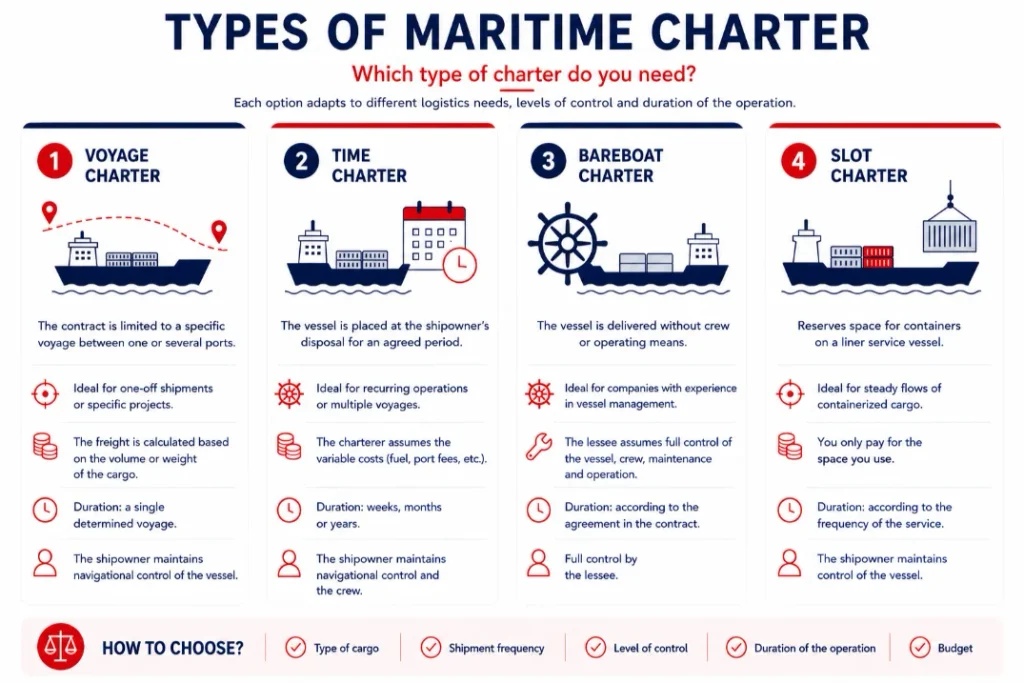
Types of ship chartering according to logistics needs
There is no single chartering arrangement suitable for every operation. The choice will depend on the type of goods, the frequency of shipments, the level of control the company wants to take on and the logistics strategy defined for each project.
The most common arrangements are voyage chartering, time chartering, bareboat charter and slot chartering. Each responds to different operational needs and offers a different level of flexibility.
Voyage charter
In this arrangement, the contract is limited to a specific voyage between one or more previously agreed ports.
The owner makes the vessel available to the client to transport a specific quantity of goods, and the price of the service is usually calculated based on the volume or weight transported.
This is a common option for retail companies that need to cover seasonal demand peaks, or for one-off, high-volume exports in the food sector.
In this type of contract, the charterer can sub-let space to third parties if the charter party allows it. The key evidencing document for the operation is the bill of lading, which governs the relationship with the final recipient of the goods.
Standard forms such as GENCON, developed by BIMCO, one of the leading international associations in the maritime sector, are commonly used.
Time charter
In time chartering, the vessel is made available to the charterer for a set period. Unlike voyage chartering, here it is not a specific route that is contracted, but rather the availability of the vessel for the agreed period.
The owner retains nautical management of the vessel, including the crew, maintenance and insurance, while the charterer decides which voyages to undertake within the limits set out in the contract and bears the variable operating costs, such as fuel or port charges.
This arrangement is particularly attractive for companies with recurring transport needs, such as automotive manufacturers or industries that require a continuous supply of raw materials or components, as it allows them to secure space availability without taking on the investment of acquiring or managing their own vessel.
The standard charter party forms most commonly used for this type of contract are BALTIME and NYPE, widely recognised in international maritime transport.
Bareboat charter
Bareboat charter represents the arrangement that gives the lessee the greatest level of control.
In this case, the vessel is handed over without crew or operating resources. The company leasing it takes on both the nautical and commercial management of the vessel, becoming responsible for personnel, maintenance, fuel and all other operating costs. The original shipowner, for its part, simply receives a periodic rent and is exempt from liability for the commercial operation or for any damage to the goods transported.
This option is aimed mainly at companies with their own maritime structure and experience in the direct management of vessels. It is regulated internationally by the United Nations Convention on Conditions for Registration of Ships, and one of the most widely used contracts for this type of operation is the BARECON form, developed by BIMCO.
Slot charter
Slot chartering involves reserving a set number of container spaces, measured in TEU or FEU units, on board a regular liner vessel, without the need to charter the entire vessel.
There are two main sub-types: ordinary slot chartering, usually contracted voyage by voyage, in which the charterer pays for the reserved space whether or not it is used in full, and the vessel sharing agreement, established between shipping lines on a reciprocal basis without any monetary consideration.
It is a flexible alternative for companies with steady cargo flows that do not require the full capacity of a vessel, and it helps optimise costs in sectors such as retail, distribution or the technology industry. If you would like to explore how this arrangement complements other maritime transport options, we recommend our article on FCL vs LCL. The standard form used for this type of operation is SLOTHIRE, developed by BIMCO.
Critical clauses and cost management in a charter party
Beyond the type of contract chosen, one of the keys to the success of any ship chartering operation lies in correctly negotiating the charter party.
This document sets out the obligations of each party and governs aspects that can have a direct impact on the final cost of the transport.
One of the most important concepts is laytime, that is, the agreed period for carrying out loading and unloading operations without generating additional costs.
If that period is exceeded, demurrage comes into play, a financial compensation that the charterer must pay for the extra time the vessel remains idle.
Another relevant concept is deadfreight. This situation arises when the charterer fails to deliver all the cargo committed to under the contract and must still bear the cost corresponding to the reserved space that ultimately remains empty.
The regulations also govern liability for loss, damage or delay of the cargo. In Spain, these matters are governed by the Maritime Navigation Act, which incorporates the liability limits set out in the Hague-Visby Rules, fixed at 666.67 units of account per package, and which caps compensation for delay at a maximum of 2.5 times the freight payable on the delayed goods. This limit only disappears if wilful misconduct or intentional wrongdoing on the part of the carrier is proven.
Chartering for project cargo and special goods
Not all goods can be transported using conventional maritime services.
Industrial projects, energy infrastructure or oversized cargo require specific planning from the earliest stages of the project.
This is the case with project cargo, where each operation is custom designed taking into account the dimensions of the goods, the equipment needed to handle them, the availability of port infrastructure and the constraints that exist during transport. In the most complex cases, this type of cargo requires vessels equipped with Flo/Flo (float-on/float-off) submersion systems, particularly suited to structures that cannot be handled with conventional cranes.
Components such as wind turbines, transformers, industrial reactors or large metal structures require specialised vessels, stowage studies, special permits and precise coordination among all the participants in the logistics chain.
The same level of specialisation is needed for goods that must be kept under controlled conditions, such as pharmaceuticals, cosmetics or perishable foods. In these cases, chartering can be combined with reefer solutions and rigorous documentation management to guarantee the integrity of the goods throughout transport.
Why choose Grupo SUARDIAZ for your ship chartering services
Grupo SUARDIAZ offers a comprehensive ship chartering service through SN Shipbrokers, its division specialising in vessel broking.
Its offering combines available space on Suardiaz Shipping Lines vessels with sourcing capacity on the international market when the needs of the operation require it, making it possible to offer solutions tailored to different types of goods and projects.
In addition to its chartering service, Grupo SUARDIAZ brings together a broad logistics offering that includes sea, road and rail transport, port operations, customs management, customs warehouses and project cargo solutions, making it easier to coordinate both national and international logistics operations.
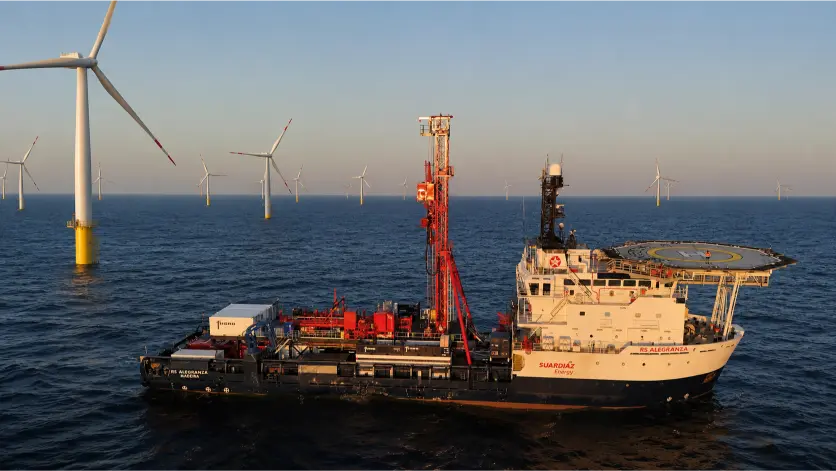
The company holds Authorised Economic Operator (AEO) certification and continues to strengthen its operational capacity with the addition of new vessels powered by Liquefied Natural Gas (LNG) and specialised vessels such as the RS Alegranza, designed to provide technical and logistics support to the offshore wind sector.
Ship chartering is a strategic tool for companies that need to transport large volumes of goods or manage highly complex logistics operations. Choosing the right type of contract, understanding the responsibilities of each party and properly planning aspects such as documentation management, port operations or loading times can make the difference between an efficient operation and a significant increase in costs.
Working with a partner experienced in ship chartering, multimodal transport and comprehensive project management makes it possible to face these challenges with greater confidence, optimising the logistics chain and tailoring each solution to the real needs of every operation. Contact us and our team will assess your operation to offer you the most suitable solution.